|
|
中文名稱
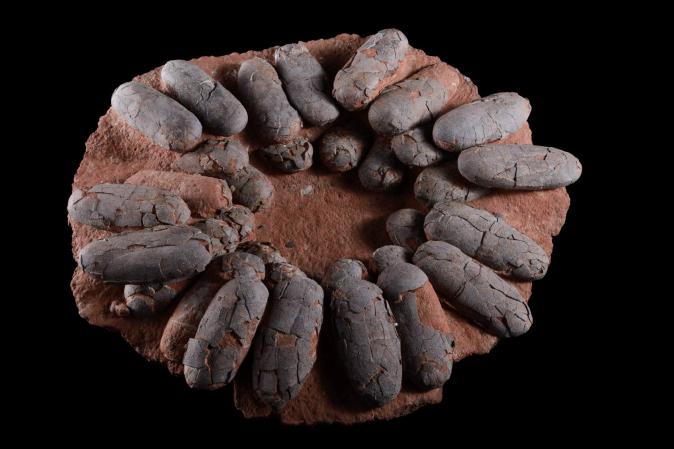
Chinese Title | 竊蛋龍窩蛋 |
英文名稱
English Title | Dinosaur Eggs |
學名
Scientific Name | Oviraptor sp. |
出土地
Locality | 中國,江西,贛州 (Ganzhou, Jiangxi Province, China) |
年代
Date | 白堊紀晚期 (距今約8400萬年前);Late Cretaceous Period (about 84 million years ago) |
尺寸
Dimensions | 70 x 60 x 18 cm |
典藏編號
Accession Number | 0009851 |
竊蛋龍(Oviraptor),拉丁文的意思是「偷蛋的賊」,又名偷蛋龍,屬於獸足龍類。1923年一群古生物學家在內蒙古南戈壁發現了一個小獸足類恐龍骨架正爬在一窩原角龍的蛋上,古生物學家認為牠是在偷吃原角龍的蛋,所以把牠命名為竊蛋龍。後來更多的竊蛋龍蛋化石被發現且蛋窩內有未孵化的胎胚,比對下才證實牠是在保護自己的蛋而非偷蛋。雖然1995年美國古生物學家在《科學》期刊為其平反,但根據國際動物命名法規,生物命名後是不能改變的。
我國國立自然科學博物館程延年博士結合跨國研究團隊,根據中國江西所發掘出的竊蛋龍化石進行研究,2005年在《科學》期刊上發表竊蛋龍的生殖機理論述,引起學術界重視。在這些化石中,發現骨盆裡有兩顆未產下的完整蛋。由這兩顆位於產道的蛋,再與成雙多層次排列於巢穴中的蛋對照,推斷竊蛋龍應是多次產下少量的蛋,而非單次產下大量的蛋。
竊蛋龍是群體生活,成年的竊蛋龍把卵產在用泥土築成的圓錐形巢穴中。由這件窩蛋化石推論生育行為,母竊蛋龍不僅會認巢,還會多次重返同一巢中生蛋,每次產下成對的蛋,依序環狀排列。依科學家目前的研究推斷,竊蛋龍不僅產卵、護巢,也可能會孵蛋。
"Oviraptor" is Latin for "egg taker" or "egg seizer" and is a theropod dinosaur. The first fossil specimen of this species was discovered by paleontologists in Mongolia in 1923 atop a pile of eggs belonging to protoceratops. They assumed that the oviraptor was trying to take the eggs, and from where came its name. However, after more specimens with embryos were found, it showed that the eggs probably belonged to oviraptor itself, which serves as an evidence that it was most likely trying to protect the eggs instead of stealing them. Although paleontologists expressed their discontent in Science in 1995, according to International Code of Zoological Nomenclature, once an animal has officially been named, it cannot be changed.
National Museum of Natural Science curator Dr. Cheng Yen-Nien and his international research team conducted research based on specimens from China's Jiangxi Province and published their findings and hypothesis regarding the oviraptor's reproductive mechanism in Science in 2005, which have raised much attention of the international academic communities. Among these specimens, they found the fossil of a pelvis and hind leg with eggs that had complete shells still inside the body. Comparing the pair of eggs still in the oviducts to lots of eggs lined in layers in the nest, it showed that the oviraptor probably laid one pair of eggs at a time, instead of laying a clutch of eggs all at once.
The oviraptors lived in groups. Adults would make conical nests out of dirt. From this fossilized nest specimen, it was deduced that the mother would probably not only recognize her own nest, but also often return to the nest to lay eggs, each time laying a pair of eggs in circlular alignment. Such evidence led the scientists to prove that the Oviraptors not only laying and protecting eggs but also brooding them.
|