|
|
作品中文名稱
Chinese Title | 耶穌受難 |
作品英文名稱
English Title | The Crucifixion |
作者中文姓名
Artist (Chinese Name) | 奧格斯堡畫派 |
作者原文姓名
Artist | Augsburg School |
國籍
Nationality | 德國 |
生卒年
Artist Dates | 約1500-1600 |
年代
Date Made | 年代不詳 |
材質
Medium | 油彩、木板 |
尺寸
Dimensions | 126.4 x 53.3 公分 (cm)含框145x73 公分 (cm) |
典藏編號
Accession Number | 0001845 |
德意志的奧格斯堡(Augsburg)在十五世紀中葉是歐洲的政、經、文化重鎮,並在十六世紀人文主義思想於歐洲北方的傳播上扮演重要角色,各類藝術在此尤其蓬勃發展。而本件作品正是展現奧格斯堡哥德晚期與新興文藝復興風格並存、融合的佳例。
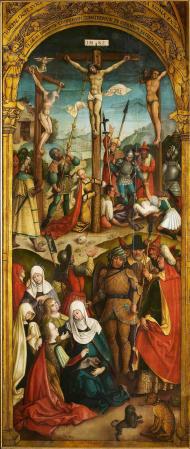
畫中場景為聖經典故中耶穌拯救世人的高潮事件——十架受難。崩裂的地勢將複雜的畫面區隔為上下兩個部份,下方由左而右分別為跟隨耶穌的婦女、昏厥的瑪利亞與其他信眾,羅馬士兵及猶太群眾;上方以十字架為畫面中軸,伴隨著左右同受釘刑的盜賊。背景的中央平原連接遠方城市與起伏重疊的山巒,凸顯畫面縱深層次的豐富。空中由深而淺的藍天捲雲重壓而下,唯耶穌身上的白色布巾孤凌飄盪,透露風起雲動、天地變色之勢。相對之下,十架下方則是一片喧囂、情緒各異的人們:依依不捨的信徒、為耶穌解渴的士兵、指點評論的猶太人、舉手感嘆的百夫長(Centurion)、爭奪耶穌衣袍而糾打叫囂的羅馬士兵。
在風格上,人物衣袍縐褶的大弧線條、厚重堆疊的布料質感與稜角分明的造形,皆為德國哥德晚期的風格特徵;而畫緣建築框架的古典柱式、天使形象與葉串裝飾則反映出文藝復興的偏好,顯現中古晚期過渡至文藝復興的轉折發展。(于禮本)
Augsburg in Germany was a center of politics, economics and culture in mid-fifteenth century Europe. All styles of art flourished here. This piece is an excellent example of the late Augsburg Gothic and early Renaissance styles combined together.
The scene depicted in the painting is the Crucifixion. The breaking earth divides the complex scene into top and bottom sections. At the bottom from left to right are women and child followers of Jesus, the fainted Mary and other believers, Roman soldiers and a crowd of Jews. The top half features Jesus on the cross in the center along with criminals on the left and right also being crucified. The central plain in the background connects with the distant city and rolling hills to add to the depth and layers of the painting. The sky fades from dark blue to light under roiling clouds pressing down upon the image, only the white loincloth of Jesus floats in the wind and serves as an indication of a coming storm and shifting earth. In contrast to the solemn scene, beneath the Cross is a rabble of people all feeling different emotions. Reluctant disciples, a soldier helping Jesus quench his thirst, judgmental Jews, a lamenting centurion with hands in the air, and Roman soldiers clamoring over Jesus' clothing. Many details carry religious symbolism and allegorical meaning. For example, the small, howling dog facing the larger leopard in the bottom right corner. These two elements have represented greedy and ignorant people in Bestiary fables since ancient times. They form a contrast to Christ who will rise after three days in the tomb, as well as serving as a critique and foretelling of future events.
In terms of artistic elements, the wide arcs and lines of the garment, thickly layered textured fabric material and clear corners and angles are characteristics of the late German gothic style. The classic columns framing the painting, the symbols of angels, leaves and vines as decorations draw on characteristics of the Renaissance. Together they present the transition period of the late Middle Ages developing into the Renaissance. (Li Pen YU)
|