|
|
作品中文名稱
Chinese Title | 聖母子在榮光中 (聖壇正面鑲板) |
作品英文名稱
English Title | Madonna and Child in the Glory (Altar frontal) |
作者中文姓名
Artist (Chinese Name) | 作者不詳 |
作者原文姓名
Artist | Anonymous |
國籍
Nationality | 西班牙 |
生卒年
Artist Dates | 年代不詳 |
年代
Date Made | 約1200年 |
材質
Medium | 蛋彩、木板 |
尺寸
Dimensions | 106 x 103 公分 |
典藏編號
Accession Number | 0003936 |
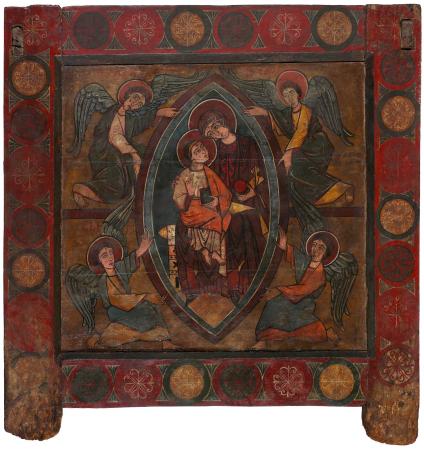
聖壇鑲板畫是西班牙仿羅馬藝術(Romanesque)中難得保存豐富的類型,尤其集中在加泰隆尼亞(Catalonia)與亞拉岡(Aragon)地區。本件聖壇鑲板中托扶著象徵宇宙天體的藍色榮光圈(mandorla)之四位天使已暗示出其隨侍對象的尊榮;他們分別是兩位天使長加百列(S. GABRIEL)與彌迦勒(S. MICHAEL),以及九層天使等級中最高階的基路伯智天使(CHERUBIM)與撒拉弗熾天使(SERAPHIM)。而光圈中坐在寶座上的聖母右手搭扶在愛子肩上,垂頭望向懷中耶穌,左手的紅色果實則象徵瑪利亞是「新夏娃」,讓救世主降生人間,為人類帶來新希望。戴著樸素圈冠(diadem)的耶穌則以「基督君王」(pantocrator)的姿態出現,仰望母親的同時舉手祝福,並拿著象徵智慧與誡命的書本,突顯其智慧君王的本質。母子兩人相迎的頭部動作與交會的眼神讓一絲親密在肅穆中緩緩流露。
簡單鮮明的藍、紅、黃褐為主導顏色,交錯間隔的出現在人物服裝與邊框花飾上。黑色有力的線條勾勒出明確的形體輪廓與細節,在平面性與線條性的交織下營造出獨特的律動與古樸感。四分之三斜側身軀並強調親子互動的聖母子類型,以及稜角分明的裝飾性衣褶風格等,都反映出西班牙仿羅馬繪畫在十二世紀末到十三世紀初所受到的義大利-拜占廷藝術影響。然而邊框圓環中結合四瓣心狀花朵與十字的裝飾圖案卻承襲了加泰隆尼亞地區七世紀以來西哥德傳統的紋樣,整體作品反映出多元文化歷史的特色。(于禮本)
This work is a Romanesque altar panel painting produced in Spain. Panel paintings are usually fixed at the front and on the sides of the alter table depicting stories related to Christian doctrine. This type of Romanesque art is well-preserved in vast quantities, mostly in Catalonia and Aragon, Spain.
In early Christian art, the portrayal of Holy Mary came in various types, amongst which "Madonna and Child in Glory" was one of the earliest, with the image of Holy Mother standing or sitting with Jesus in her arm, and both enclosed by a halo. In this picture, four angels support a mandorla from four directions. In the encircle of light, the eyes of the Madonna and the Child meet, revealing endearment in solemnness. The red fruit in the left hand symbolizes that Holy Mary is the "New Eve" giving birth to the Savior and thus bringing hope to mankind. Jesus, crowned with a simple diadem, looks up to His Mother and raises one hand to give blessing, while his other hand holds the book of Wisdom and Commandments, all indicating His heredity as Lord of Wisdom.
The whole picture remains bright and simple with blue, red and yellow as base colors and with the black outline of characters that creates some rhythm in the archaic piece. The posture of the Mother and the Son with sidelong interaction in between and the angular folds in the clothes reflect the influence of the Byzantine art over Spanish Romanesque paintings of the late 12th century and the 13th century. Around the painting on the frame, the rings encircle a four-leaf clover and a cross, which are traditional patterns inherited from the Visigoths in Catalonia that can be dated back to the 7th century. The whole piece of work reflects multi-cultural and historic features.(Li Pen YU)
|