|
|
作品中文名稱
Chinese Title | 花卉靜物 |
作品英文名稱
English Title | Still Life with Flowers |
作者中文姓名
Artist (Chinese Name) | 楊‧彼特‧布魯赫爾 |
作者原文姓名
Artist | Jan Pieter BRUEGHEL |
國籍
Nationality | 法蘭德斯 (Flemish) |
生卒年
Artist Dates | 1628-1664/1684 |
年代
Date Made | 年代不詳 (undated) |
材質
Medium | 油彩、畫布 (oil on canvas) |
尺寸
Dimensions | 59.5 x 43.4 公分 (cm) |
典藏編號
Accession Number | 0012415 |
擅長花卉靜物的楊‧彼特‧布魯赫爾(Jan Pieter Brueghel, 1628-1664/1684)是法蘭德斯著名的布魯赫爾藝術世家第四代成員;其曾祖父彼特‧布魯赫爾一世(Pieter Bruegel the Elder, 1525-1569)的風景與農民風俗畫為法蘭德斯繪畫在畫類、主題與構圖上樹立新典範,影響深遠;而祖父楊‧布魯赫爾一世(Jan Brueghel the Elder, 1568-1625)的花卉靜物作品更是自十七世紀初以來便為當代與後輩畫家效仿之對象。
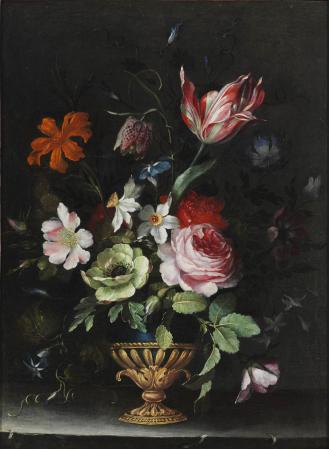
本作承襲了楊‧布魯赫爾一世花卉景物畫的傳統,裝有各色花朵的藍漆鍍金飾雕花瓶被安置在石板桌面中央,單一的深色背景烘托出前景花朵的豔麗。盛開的牡丹、玫瑰與水仙以花心朝左前方或右前方的角度展現複瓣層疊的密實與蕊心花柱的精巧細緻;深淺不一、或窄或圓的銀綠葉片搭配其中,緊密相鄰,使花束顯得豐實滿溢。稍高處的三朵橘色、白底紅斑、與藍色的花朵以左右對稱中軸的方式齊高排列,而後從中延伸出一朵更高、更大、紅白相間、半綻放的鬱金香作為花束之冠。盤捲其間的纖細牽牛花枝、細碎葉苞,為富麗貴氣的花束增添一絲清秀淡雅。看似寫實逼真的花束確為理想的組合設計,除了不同時節的花卉種類被齊集一堂之外,畫家透過刻意的角度安排減低了每一朵花被遮掩的程度。此種靜物畫除了悅人眼目,彰顯花卉迷人色調、瓣蕊的精巧透薄,與多元罕見種類之外,也反映出當代歐洲方興未艾的花卉植栽與擺設昂貴裝飾花束的風潮。與此文化背景相連結,花卉靜物畫也因此常暗藏警惕追求奢華、謹記人世虛空之意,一如畫中部分開始枯萎泛黃的花葉,以及桌面石板邊緣的碎裂痕跡,揭示了歲月流逝、好景不常之命運。 (于禮本)
A master painter who specialized in flower still lifes, Jan Pieter Brueghel (1628–1664/1684) was a member of the fourth generation of the celebrated Brueghel family in Flanders. The landscape and genre paintings of his great grandfather Pieter Bruegel the Elder (1525–1569) established a new paradigm in the genres, themes, and compositions of Flemish painting. By the early 17th century, painters began to often emulate the flower still lifes created by his grandfather Jan Brueghel the Elder (1568–1625).
This painting follows the tradition of Jan Brueghel the Elder. A blue lacquer and gilt vase filled with various flowers stands at the center of a stone ledge. The dark and monochromatic background accentuates the brilliance of the flowers in the foreground. Peonies, roses, and daffodils in full bloom face toward the front left and front right. These angles reveal the artist’s refined and exquisite depictions of petal layers and stamens. With thin and round silver-green leaves in abundant gradation tightly arranged in between, the overall bouquet appears overflowing and resplendent. On the upper part of the canvas, the three daisies, painted with red flecks over white, are arranged symmetrically from the center to match the blue flowers. Behind them is a taller, bigger, half-blooming tulip in red and white that stretches to the crown of the bouquet. The offshoots of morning glories and small curled bracts in between add a refreshing and elegant touch to this dazzlingly luxurious bouquet. A realistic bouquet is indeed an ideal design. In addition to putting together flowers of various seasons, the artist purposefully lowered the level by which each flower is covered by other flowers through the skillful application of different angles. With its emphasis on the attractive hue of flowers, delicate and transparent petals, and diverse and rare floral varieties, this kind of still life is particularly pleasing. In addition, it also reflects a contemporary trend of the time which focused on expensive floral decoration in Europe. In terms of cultural background, this flower still life also reminds people of the vanity which underlies the pursuit of luxury with hints of withering flowers and a cracking edge on the ledge — which suggests that good times cannot always last forever. (Li Pen YU)
|